
Loyalty and commitment
Filipino workers are known for perseverance and loyalty to their employer – resulting in low turnover and a stable team.


 Recruitment from the Philippines
English-speaking, vetted Filipino workers for Hungarian manufacturing, construction and logistics companies. Our partner agency sources the candidates; we coordinate Hungarian permits, documentation and arrival – planned arrival 2–3 months.
Philippines · Southeast Asia
For decades the Philippines has been one of the world's largest sources of overseas workers: millions of Filipinos work legally abroad. Hungarian employers get access to candidates who know how overseas contracts work, hold documented qualifications and communicate in English – an official language of the Philippines.
Recruitment is regulated on both sides: in Hungary an employment-purpose residence permit and visa are required; in the Philippines the employer must be accredited and the contract approved under DMW (Department of Migrant Workers) rules. A licensed partner agency sources the candidates, while Primework Group Hungary Kft. provides consulting, documentation and coordination – one timeline, one budget, one contact person.
2–3 months
planned arrival from contract
100%
legal employment and residence
30 days
replacement guarantee from start
20+
recruitment countries
Other directions
We also recruit from India, Nepal, Bangladesh, .
See all directionsBenefits
Filipino workers are known for perseverance and loyalty to their employer – resulting in low turnover and a stable team.
The Philippines is one of Asia's largest English-speaking countries. Communication on the shop floor and in the office works from day one.
Many candidates have higher or technical education and experience in construction, manufacturing and logistics.
A culture of cooperation and respect for supervisors makes onboarding into Hungarian organisations easier.
They adapt quickly to shift systems and new procedures – shortening onboarding.
If a worker does not meet expectations within 30 days of starting, we provide a replacement free of charge as set out in the agreement.
The process runs in five stages: agreement and accreditation, recruitment, the Philippine procedure (DMW), Hungarian permits and relocation. Each stage has clear steps and documents – below we show what happens and who covers the costs.
2–3 months
planned arrival – depending on authority capacity
5 stages
one coordinator runs the whole process
100%
compliance with Hungarian and Philippine rules
Process stages
The process starts with the agreement with Primework Group Hungary Kft. and preparation of the employer accreditation.
Agreement and accreditation
After signingAccreditation starts after signing the agreement with Primework Group Hungary Kft.; third-party fees are agreed in writing in advance.
We start from the job, not the CV. Our partner agency pre-selects candidates; video interviews on request.
Job profile and contract
Step 1Duties, required qualifications, pay, shift pattern and housing. The contract is drafted in a form acceptable to the DMW.
Pre-selection in the Philippines
Step 2The partner agency checks CVs, references and TESDA certificates.
Candidate selection
Step 3We present a shortlist. The final decision is the employer's. Video interviews on request; practical tests are a paid extra.
Employer accreditation, DMW contract approval, medical exam, PDOS training and OEC exit clearance.
Employer accreditation
In parallelEmployer documents and employment terms verified under Philippine requirements.
Contract approval (DMW)
In parallelThe contract must meet Philippine rules – no recruitment fees may be charged to the worker.
Medical exam, PDOS and OEC
Before departureMedical exam at an accredited clinic, PDOS pre-departure training and OEC exit clearance.
Employment-purpose residence permit at the National Directorate-General for Aliens Policing (OIF), visa at the Hungarian Embassy in Manila.
Documentation
Step 4Company data, job description, employment terms and declarations – checked for compliance before filing.
Residence permit application
Step 5The employment-purpose residence permit is decided by the OIF; processing time depends on the authority's capacity.
Visa at the Embassy in Manila
Before departureBased on the permit, the candidate collects the entry visa at the Hungarian Embassy in Manila.
Flight, transfer, housing, address registration, TAJ and tax ID numbers, onboarding – with a coordinator on both sides.
Flight and transfer
ArrivalFlight from Manila, airport transfer and group pick-up by an English-speaking coordinator.
Housing and registration
First weekHousing, address registration, residence card collection, TAJ number, tax ID and bank account.
Safety training and onboarding
First weekHealth and safety training and job instructions in English, a team supervisor and the first working day.
30-day period and guarantee
Month 1The success fee is due after a successful 30 days from the start of work; the contractual replacement guarantee applies within this period.
Typical timeline
Planned arrival: 2–3 months – depending on authority capacity
Job profile and offer
01Candidate selection
02Accreditation and DMW procedure
03Residence permit and visa
04Arrival and first working day
05Cost of employment
Upfront fee – HUF 150,000 + VAT / person
EmployerDue after the agreement enters into force, on invoice, payable within 8 days.
Success fee – HUF 200,000 / 250,000 + VAT / person
EmployerHUF 200,000 for unqualified roles, HUF 250,000 for qualified roles; due after a successful 30 days from the start of work.
Official fees and translations
EmployerProcedure fees, translations and third-party fees are not included – agreed in writing in advance.
Travel and relocation
EmployerFlight from Manila, transfer, initial housing and starter equipment.
Practical tests (option)
EmployerSkills tests at the employer's request – a paid extra.
Fees are net amounts plus 27% Hungarian VAT: HUF 444,500 gross per person for unqualified roles and HUF 508,000 for qualified roles. Official fees, translations, travel and other third-party costs are separate items.
Ready to start
Recruitment partner in the Philippines
Candidates are sourced in the Philippines by our licensed partner agency, Praxis International Staffing and Management. Primework Group Hungary Kft. provides consulting, documentation and coordination; the final choice of candidates is the employer's.
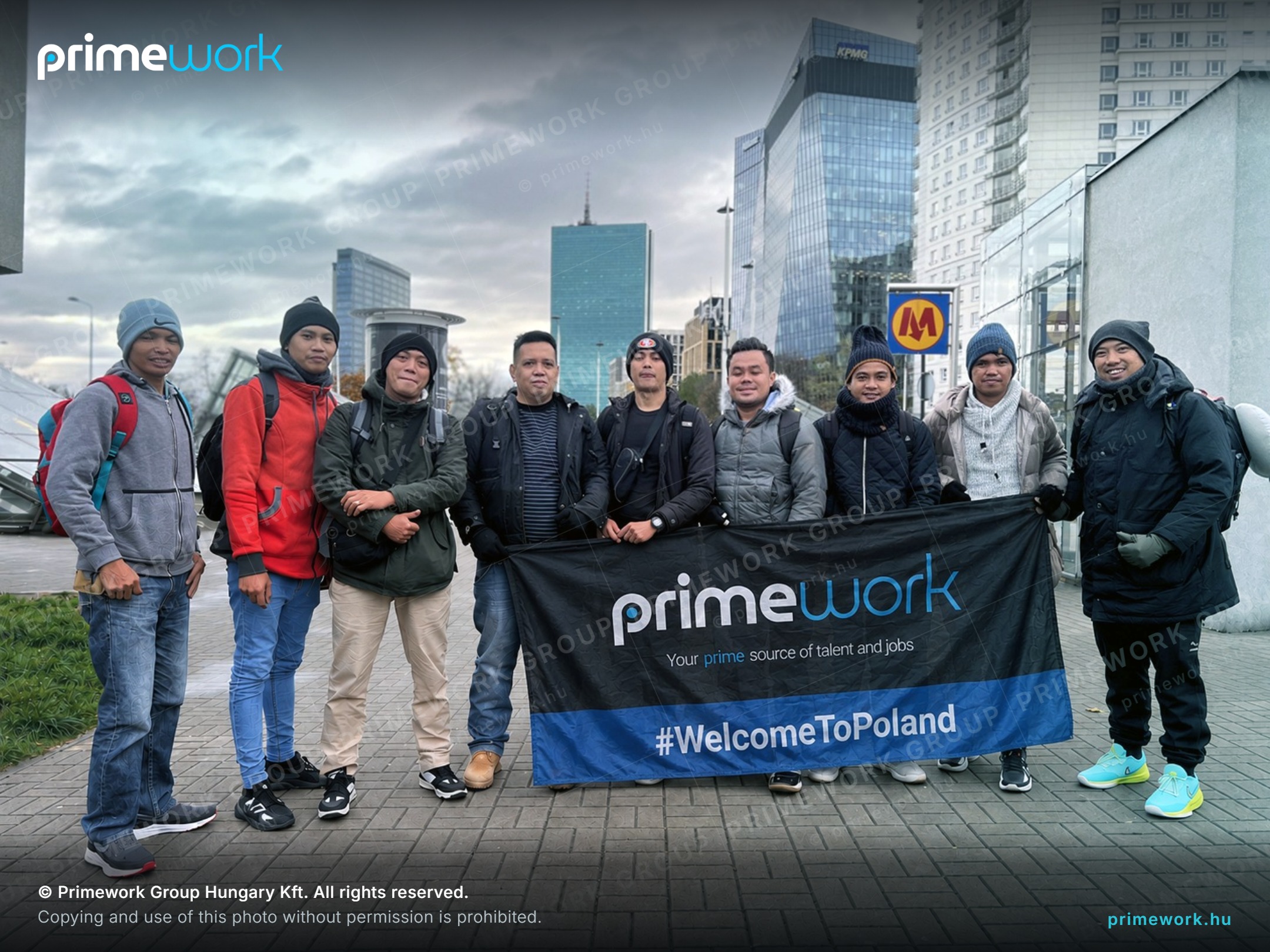
praxisintl.com.phSelected photos from our work: arrivals, onboarding and day-to-day support for our groups.
Where Filipino workers excel
Positions
Most often roles requiring consistent quality, shift work and certified skills. TESDA certificates help verify qualifications before the interview. Practical tests are a paid extra.
Need a different profile? We also recruit from other countries in Asia, Africa and South America.
Typical differences in process and candidate profile.
| Criterion | Philippines | Other directions |
|---|---|---|
| English proficiency | Very good – official language | Usually basic |
| Planned arrival | 2–3 months | Varies by country and procedure |
| Turnover | Low – long-term contracts | More frequent employer changes |
| Vocational certificates | TESDA – recognised qualification system | Varying documentation |
| Formalities | Hungarian permit + DMW + visa | Depends on country and permit type |
Cultural integration
Filipinos value close relationships, respect and cooperation. A few simple steps make onboarding faster and teams more cohesive.
Language barrier
Safety materials and job instructions in English, pictograms on the shop floor and basic Hungarian phrases during onboarding.
Cultural differences
Briefings for Hungarian managers (indirect communication, role of hierarchy) and orientation for workers before departure.
Feeling of isolation
Group recruitment, an English-speaking team supervisor and help staying in touch with family.
Turnover and competition
A clear path to extension and promotion, predictable schedules and regular reviews of conditions.
Short answers about recruiting workers from the Philippines.
The Philippines is one of the world's largest English-speaking labour markets with a long tradition of working abroad. Candidates know international standards, hold documented qualifications (TESDA certificates) and show low turnover – meaning shorter onboarding and a stable team.
1) Needs analysis and job description, 2) pre-selection in the Philippines through our partner agency (CVs, references, TESDA certificates; video interviews on request), 3) employer accreditation and DMW contract approval, 4) employment-purpose residence permit at the OIF, 5) visa at the Hungarian Embassy in Manila, 6) arrival, housing, address registration and onboarding.
Planned arrival is 2–3 months. Timing depends on the capacity of authorities, consulates, embassies and visa systems, and on the applicable procedure; it is not a guaranteed deadline.
An upfront fee of HUF 150,000 + VAT per person after the agreement enters into force, plus a success fee of HUF 200,000 + VAT (unqualified) or HUF 250,000 + VAT (qualified) per person after a successful 30 days from the start of work. With 27% VAT that is HUF 444,500 or HUF 508,000 gross per person. Official fees, translations, travel and third-party costs are separate and agreed in writing in advance. Payment by bank transfer within 8 days of receiving the invoice.
Candidates are sourced by our licensed partner agency, Praxis International Staffing and Management. Primework Group Hungary Kft. provides consulting, documentation and coordination. The final choice of candidates always belongs to the employer.
An employment-purpose residence permit application at the OIF, an employment contract meeting legal requirements, Philippine employer accreditation and DMW contract approval, and registration of the worker after arrival. We prepare and coordinate the documents; we cannot guarantee official decisions.
Philippine rules prohibit charging recruitment fees to the worker, so the employer covers the process costs. We give you an exact budget in a written offer before starting – with no hidden fees.
The standard service is pre-selection: we check CVs, TESDA certificates and references and leave the final decision to the employer. Video interviews are arranged on request. Practical tests are a paid extra.
Yes. English is an official and teaching language in the Philippines, so most candidates communicate well. Safety training and onboarding can be delivered in English from day one.
Manufacturing and food processing, logistics and warehousing, construction, welding and metalworking, hotels and hospitality, and care – sectors where availability, shift work and consistent quality matter.
We organise flights, airport transfer, housing, address registration and first formalities (TAJ number, tax ID, bank account). Costs are covered by the employer as agreed in advance.
Within the 30-day guarantee period from the start of work, in the cases set out in the agreement, we provide a replacement free of charge (re-recruitment, documentation and arrival organisation at no extra fee). The replacement's success fee is due after their own successful 30 days.
Direction: PhilippinesWe start with a needs call and a quote. Accreditation and recruitment begin only after the agreement is signed – with an agreed arrival schedule and no promises of “instant candidates”.
Planned arrival is 2–3 months. Timing depends on the capacity of authorities, consulates, embassies and visa systems, and on the applicable procedure; it is not a guaranteed deadline.